

Feeders & Processing · Integrated
De-Stoner
The density split that makes or breaks aggregate recovery — heavy stone one way, light combustibles the other, on a cushion of air.
The Sherbrooke OEM de-stoner position integrates a dual-knife de-stoner: a vibrating deck combined with controlled air knives that fluidize the stream so heavy stone, aggregate, and glass walk one way while light wood, paper, and plastics float off the other. On C&D fines and mids lines, this is the machine that decides aggregate quality — removing the aggregates from that fraction cleanly can make or break the recovery economics of the whole project. Sherbrooke OEM engineers the position, the welded H-beam support structure, chutes, and controls integration from Sherbrooke, Quebec.
Where It Fits
- The mids fraction on C&D lines — splitting clean aggregate from light combustibles after secondary screening
- Fines lines where a magnet-plus-de-stoner pairing produces a saleable aggregate
- Any density split: stone from wood, glass from fiber, heavies ahead of optical sorting
Configuration & Options
Every unit is engineered per project — these are the configuration choices and options we quote against, not limits.
| Model class | Air-knife de-stoner (DEST class), dual-knife configuration |
|---|---|
| Width | Per throughput; engineering default around 72 in |
| Air knives | Dual knives — independently adjustable velocity |
| Deck | Vibratory, with stroke and angle tuned per stream |
| Infeed | Sized screening cut upstream — the split sharpens as the size band narrows |
| Structure | Support height per line elevation |
Construction
| Separator unit | Specialist-built de-stoner, specified and integrated by Sherbrooke OEM |
|---|---|
| Supports | H-beam structural steel members, braced and welded, by Sherbrooke OEM |
| Chutes | Formed steel plate, flanged to downstream conveyors; CHT liners per duty |
| Guarding | Guarded to OSHA requirements |
Project Photos
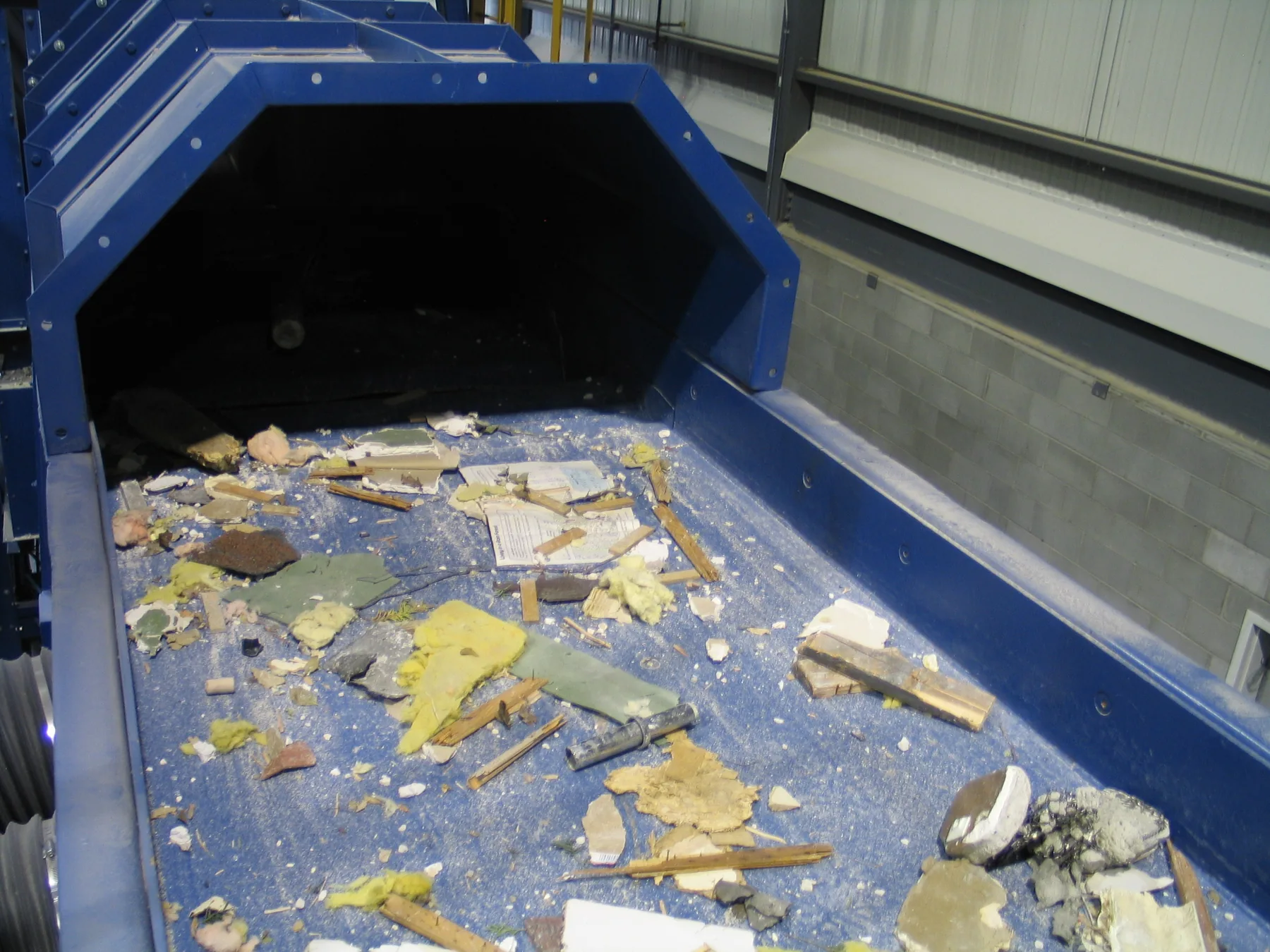
De-Stoner units built and installed by Sherbrooke OEM on recycling and C&D lines across North America.
De-Stoner — Frequently Asked Questions
Why is the de-stoner called the make-or-break machine on C&D?
Because the mids fraction is where the aggregate value lives. Pull the stone out clean and you sell an aggregate product while the light fraction upgrades too; leave stone in the lights or wood in the stone and both products downgrade. Recovery rate on the whole project often turns on this one split.
How does it actually separate?
Vibration stratifies the bed — heavies sink, lights rise — while air knives fluidize the light layer and carry it across a gap the heavies cannot jump. Deck stroke, angle, and knife velocity are the tuning levers, set at commissioning and adjustable as the stream changes.
Why does the screening cut upstream matter to a density machine?
Air drag scales with surface area, weight with volume — so a large light piece and a small heavy piece can behave alike. Narrow the size band with a proper screen cut first, and density alone decides the split. That is why the de-stoner is engineered as part of the fines line, never alone.
Need dimensions, capacity, or a budget price?
Send your material profile and layout — engineering answers with real numbers, from the team that will fabricate it in Sherbrooke.
Talk to Engineering