

Magnets & Sorters · Built in-house
Drum Magnet
Ferrous recovery built into the flow itself — the stream cascades over the rotating drum and the steel follows the shell out.
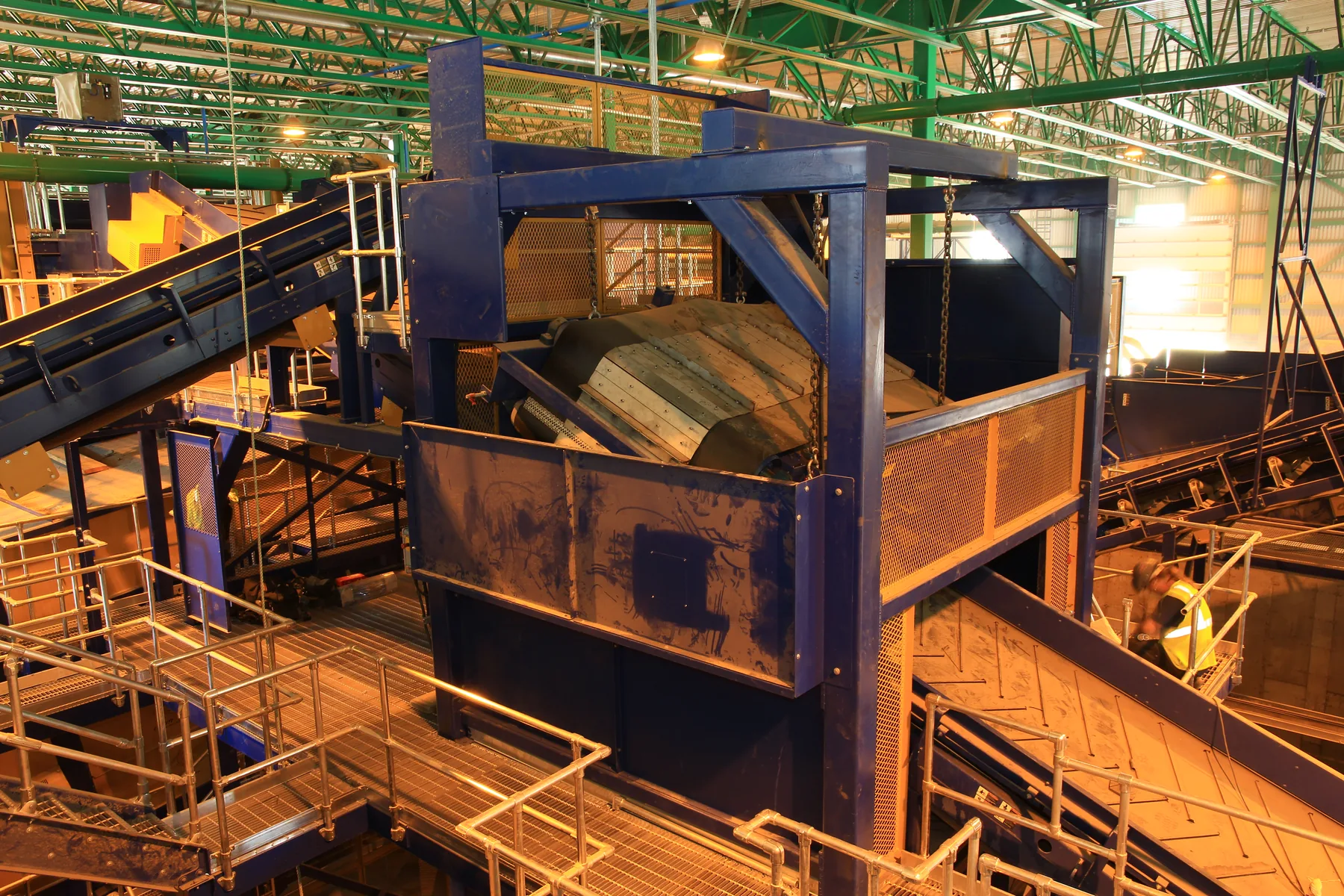
The Sherbrooke OEM drum magnet is a rotating non-magnetic shell over a fixed internal magnet arc, placed in the material cascade — typically at a conveyor discharge. As the stream pours over the drum, ferrous is held against the rotating shell and carried past the field to its own discharge while non-magnetics fall on their natural trajectory. Because the whole stream passes the field at a thin, controlled depth, the drum handles high-burden positions where an overhead must fight through the pile — it is one of the two real options, with the overhead, for ferrous duty after the A-line on C&D systems. Drum diameter, width, field arc, and chute geometry are engineered per project in Sherbrooke, Quebec.
Where It Fits
- Ferrous duty after the manual A-line on C&D systems — the alternative to an overhead magnet at that position
- High-burden, dense streams where the cascade presents material to the field in a thin layer
- Layouts without the headroom to suspend an overhead separator
Configuration & Options
Every unit is engineered per project — these are the configuration choices and options we quote against, not limits.
| Drum diameter & width | Sized per throughput and lump size |
|---|---|
| Field | Permanent or electro internal magnet arc, per recovery target |
| Field arc position | Adjustable — set to the cascade trajectory |
| Feed | Conveyor discharge or vibratory feeder presentation |
| Chute work | Ferrous and non-ferrous discharge chutes, mild steel, stainless, or CHT |
Construction
| Shell | Rotating non-magnetic (stainless) shell — wear surface replaceable |
|---|---|
| Magnet arc | Fixed internal arc on an adjustable mount |
| Drive | Geared motor drive with guarded transmission |
| Bearings | Heavy-duty pillow blocks on machined shaft ends |
| Frame & chutes | Structural steel frame and formed-plate chutes by Sherbrooke OEM |
| Guarding | All rotating parts guarded to OSHA requirements |
Project Photos
Drum Magnet units built and installed by Sherbrooke OEM on recycling and C&D lines across North America.
Drum Magnet — Frequently Asked Questions
Drum magnet or overhead magnet — which one goes after the A-line?
Those are the two real options for that position; a magnetic head pulley would get overloaded there. The drum wins when the layout suits a cascade transfer and the burden is heavy — every particle passes the field thinly. The overhead wins when the material should stay on the belt and headroom allows suspension. Layout and material profile decide.
Why does a drum handle heavy burdens so well?
Because separation happens in the cascade, not through a pile. The stream thins as it pours over the drum, so even deep-burden lines present material to the field a few pieces thick — the geometry does the work the field strength would otherwise have to.
Permanent or electro inside the drum?
Both exist. Permanent arcs cover most recycling duties with zero excitation power; electro arcs are specified when the recovery target demands a stronger, controllable field. The internal arc is also position-adjustable to match the actual trajectory at commissioning.
Need dimensions, capacity, or a budget price?
Send your material profile and layout — engineering answers with real numbers, from the team that will fabricate it in Sherbrooke.
Talk to Engineering